
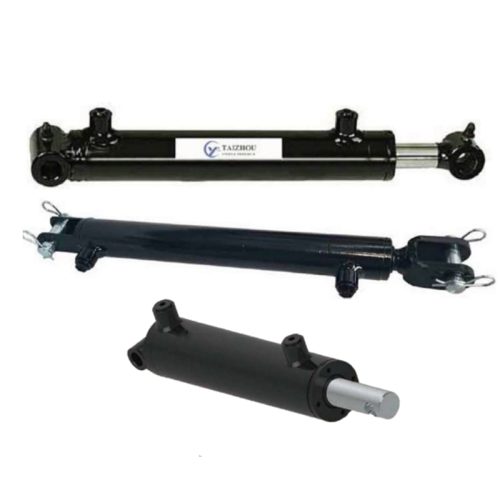
Eternal Hydraulic Standard Cylinders
Eternal Hydraulic produce about120.000 cylinders peryear and the whole process develops inour factory: cutting of raw materialsturning and milling machining, compo-nents and accessories welding, cylin-ders mounting and final testing! All the above steps are made with latestgeneration CNC machines, weldingrobotized stations and specially madeequipment.
DESIGN
Our specialized staff is at your disposalfor technical consultancy relating yourproject and the best type of materials touse based on your application. Wemostly work“on drawing”, preparingpersonalized projectsaccordingtocustomer needs.
Once the project is defined, we produceour technical drawing by CAD 2D-3Dsystems and supply it to our customerfor approval.
RAW MATERIALS
An accurate raw materials and sealsselection brings to save costs and allowto produce high quality and powerfulcylinders. For that reason, in the materials choice we consider the applicationfield of our cylinder and the environmentwhere it will work.
Specifically for chromed bars and tubeswe work only with producers or reliablesuppliers.
CONTROL
Each step of production is controlled and its progress is monitored with “production tag” filled up by theoperator at the end of each process.All cylinders are marked with product code and number of produc.tion order, in order to have a full traceability
All cylinders are controlled, during theassembling for possible defects of the components used and tested with the “methodof variation of pneumatic pressure” forpossible leakage; by sampling, or oncustomer request, cylinders are hydraulically tested on pressure.

Model Code
Welded Tee Type Cylinders-WT-3000PSI
Welded Clevis Type Cylinders -WC-3000PSI
Welded Through Hole Type Cylinders-WP-3000PSI
Adjustable Clevis Type Cylinders-WC-3000PSI
Hydraulic Tie-rod Type Cylinders-TR-3000PSI
Inverted Telescopic Cylinders-TC-21 OOPSI
Snow Plow Hydraulic Cylinders-WP-21 OOPSI
Hydraulic Cylinder Components
→Hydraulic Cylinders For Agriculture PDF2
→Hydraulic Cylinders For Agriculture PDF1
Application
A hydraulic cylinder is a device that converts hydraulic energy into mechanical energy. It is mainly composed of a cylinder, a piston rod, a sealing device and an end cover. It drives the piston to move through the pressure of the hydraulic oil, achieving linear reciprocating motion or swinging, and outputting force and speed. Hydraulic cylinders are widely used in various vehicles and machines.
In agricultural machinery, hydraulic cylinders are widely used. For example, in harvesters, they are used to adjust the lifting and tilting angles of the header to adapt to different crop heights and terrains, and improve harvesting efficiency and quality; on tractors, they are used to control the lifting and lowering of agricultural tools such as plows and harrows to achieve deep plowing and shallow plowing operations; in seeders, hydraulic cylinders can adjust the opening and closing degree of the seed tray, control the discharge amount and spacing of seeds, and ensure uniform sowing. In addition, hydraulic cylinders are also used for spray boom height adjustment of plant protection machinery, flipping action of flip plows, etc. Its advantages are small size, high power density, and flexible control, which can effectively reduce manual labor and improve the efficiency and quality of agricultural production.
In construction machinery, such as excavators, loaders, cranes, etc., hydraulic cylinders are used to drive the lifting and extension of buckets, booms, booms and other parts to complete operations such as excavation, loading, and lifting.
In forklifts, hydraulic cylinders are used to lift and lower forks to carry and stack goods. In automobiles, hydraulic cylinders can be used in automobile braking systems to provide powerful braking force.
In addition, hydraulic cylinders are also widely used in industrial machinery, such as hydraulic presses, injection molding machines, etc., to achieve operations such as opening and closing molds and molding materials. Hydraulic cylinders have the advantages of compact structure, large output force, and flexible control. They are an indispensable and important component in modern mechanical transmission.